IN2004B: Generation of Value with Data Analytics
Department of Industrial Engineering
Unsupervised Learning
Clustering Methods
K-Means Method
Hierarchical Clustering
Before we start, let’s import the data science libraries into Python.
Here, we use specific functions from the pandas, matplotlib, seaborn, sklearn, and scipy libraries in Python.
In data science, there are two main types of learning:
Supervised learning. In which we have multiple predictors and one response. The goal is to predict the response using the predictor values.
Unsupervised learning. In which we have only multiple predictors. The goal is to discover patterns in your data.
In data science, there are two main types of learning:
Supervised learning. In which we have multiple predictors and one response. The goal is to predict the response using the predictor values.
Unsupervised learning. In which we have only multiple predictors. The goal is to discover patterns in your data.
Goal: organize or group data to gain insights. It answers questions like these
Unsupervised learning is more challenging than supervised learning because it is subjective and there is no simple objective for the analysis, such as predicting a response.
It is also known as exploratory data analysis.
Marketing. Identify a segment of customers with a high tendency to purchase a specific product.
Retail. Group customers based on their preferences, style, clothing choices, and store preferences.
Medical Science. Facilitate the efficient diagnosis and treatment of patients, as well as the discovery of new drugs.
Sociology. Classify people based on their demographics, lifestyle, socioeconomic status, etc.
Clustering Methods aim to find subgroups with similar data in the database.
Principal Component Analysis seeks an alternative representation of the data to make it easier to understand when there are many predictors in the database.
Here we will use these methods on predictors \(X_1, X_2, \ldots, X_p,\) which are numerical.
Clustering Methods aim to find subgroups with similar data in the database.
Principal Component Analysis seeks an alternative representation of the data to make it easier to understand when there are many predictors in the database.
Here we will use these methods on predictors \(X_1, X_2, \ldots, X_p,\) which are numerical.
They group data in different ways to discover groups with common traits.
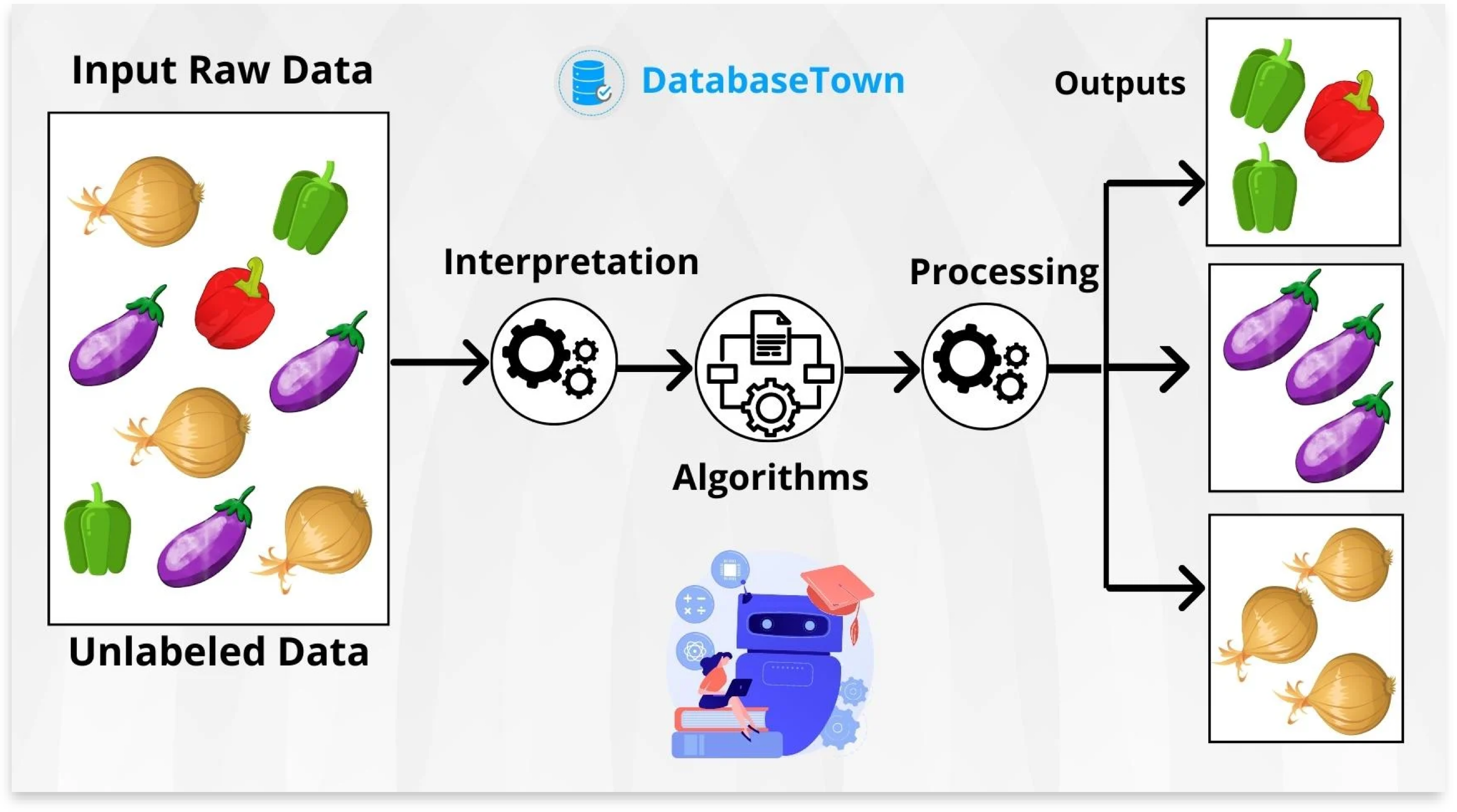
Two classic clustering methods are:
K-Means Method. We seek to divide the observations into K groups.
Hierarchical Clustering. We divide the n observations into 1 group, 2 groups, 3 groups, …, up to n groups. We visualize the divisions using a graph called a dendrogram.
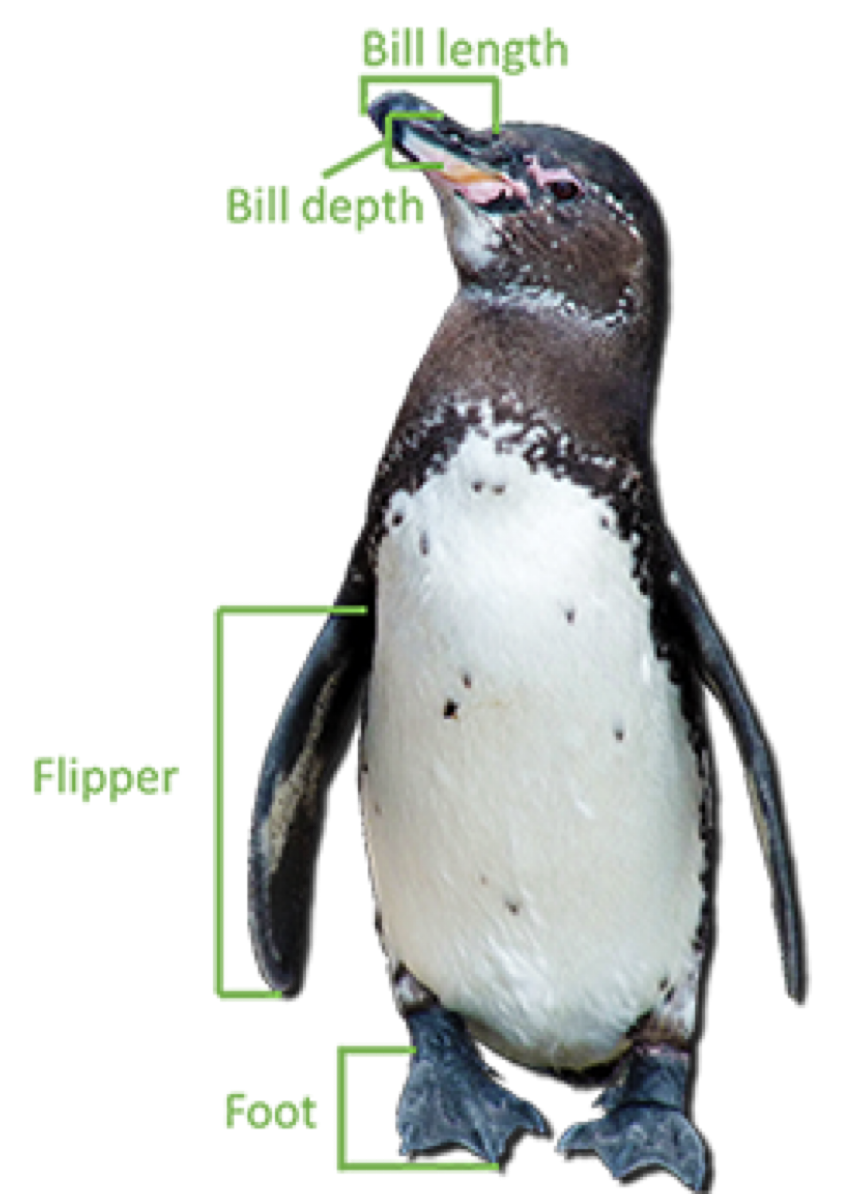
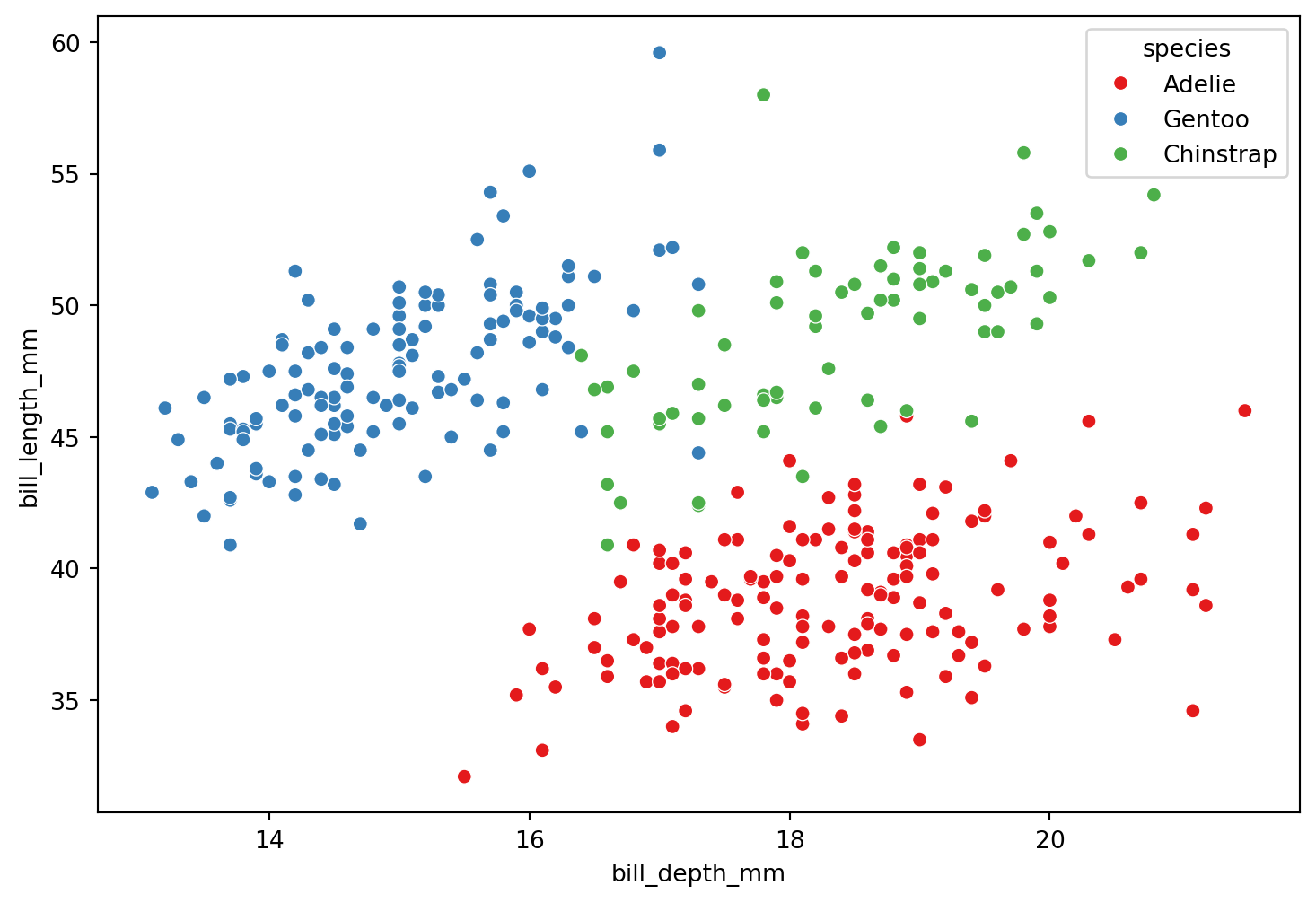
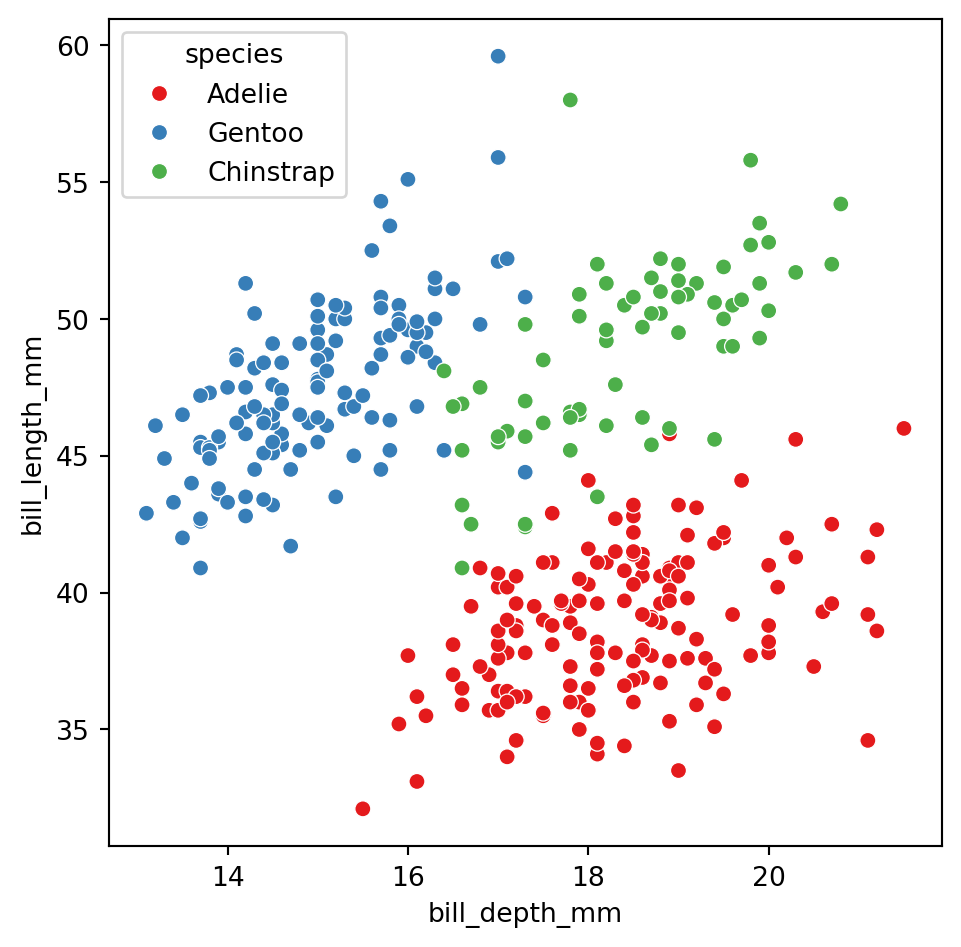
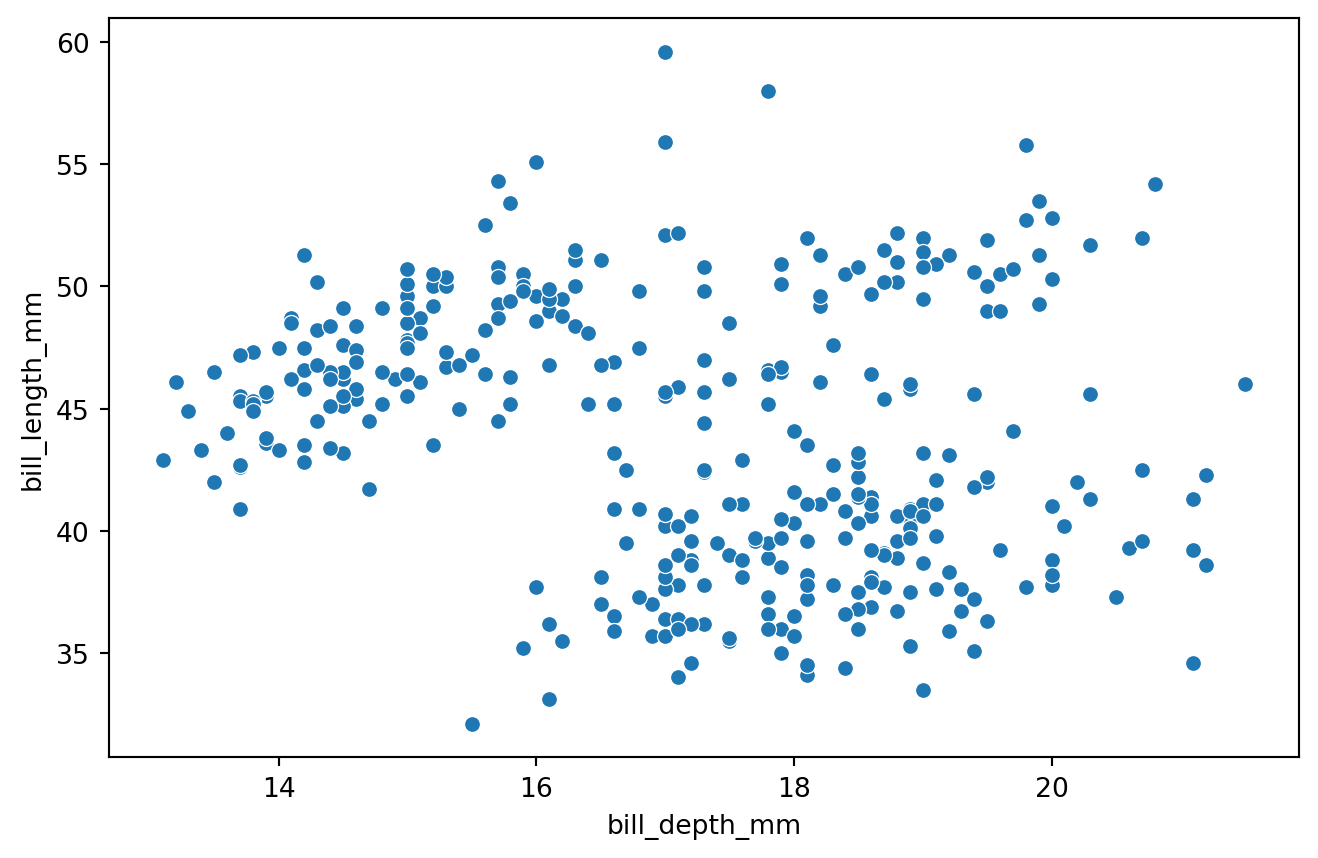
The “penguins.xlsx” database contains data on 342 penguins in Antarctica. The data includes:

| species | island | bill_length_mm | bill_depth_mm | flipper_length_mm | body_mass_g | sex | year | |
|---|---|---|---|---|---|---|---|---|
| 0 | Adelie | Torgersen | 39.1 | 18.7 | 181 | 3750 | male | 2007 |
| 1 | Adelie | Torgersen | 39.5 | 17.4 | 186 | 3800 | female | 2007 |
| 2 | Adelie | Torgersen | 40.3 | 18.0 | 195 | 3250 | female | 2007 |
| 3 | Adelie | Torgersen | 36.7 | 19.3 | 193 | 3450 | female | 2007 |
| 4 | Adelie | Torgersen | 39.3 | 20.6 | 190 | 3650 | male | 2007 |
Can we group penguins based on their characteristics?
Goal: Find K groups of observations such that each observation is in a different group.
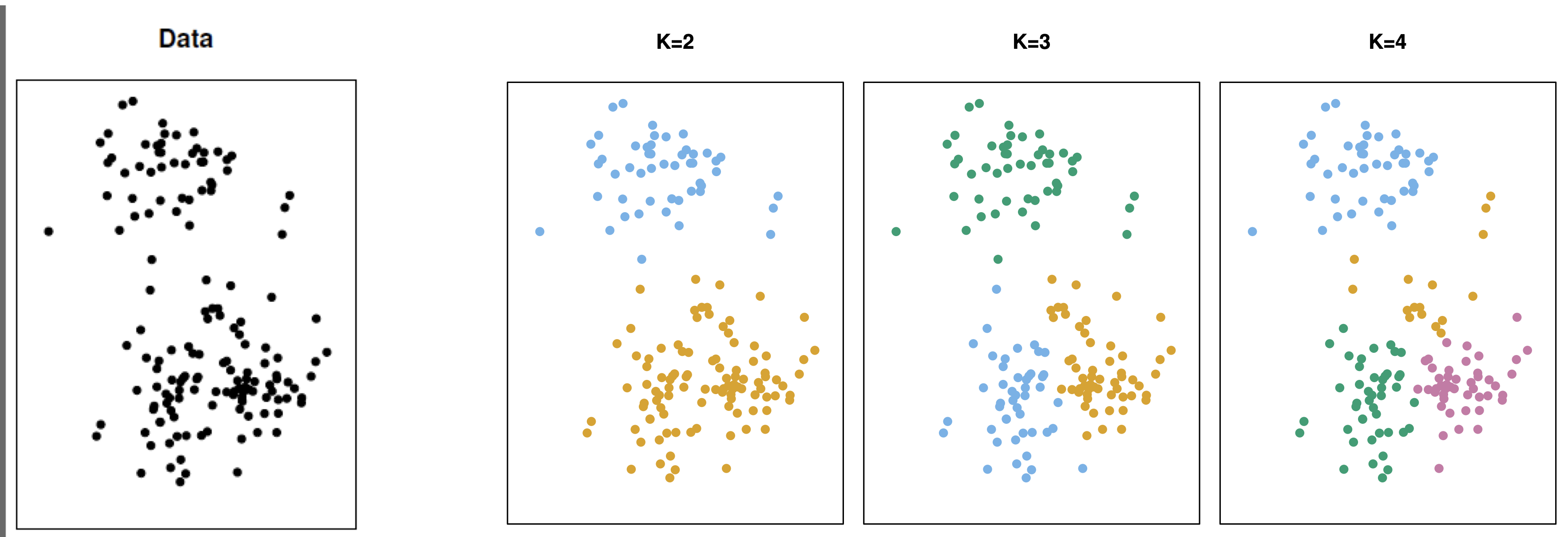
For this, the method requires two elements:
A measure of “closeness” between observations.
An algorithm that groups observations that are close to each other.
Good clustering is one in which observations within a group are close together and observations in different groups are far apart.
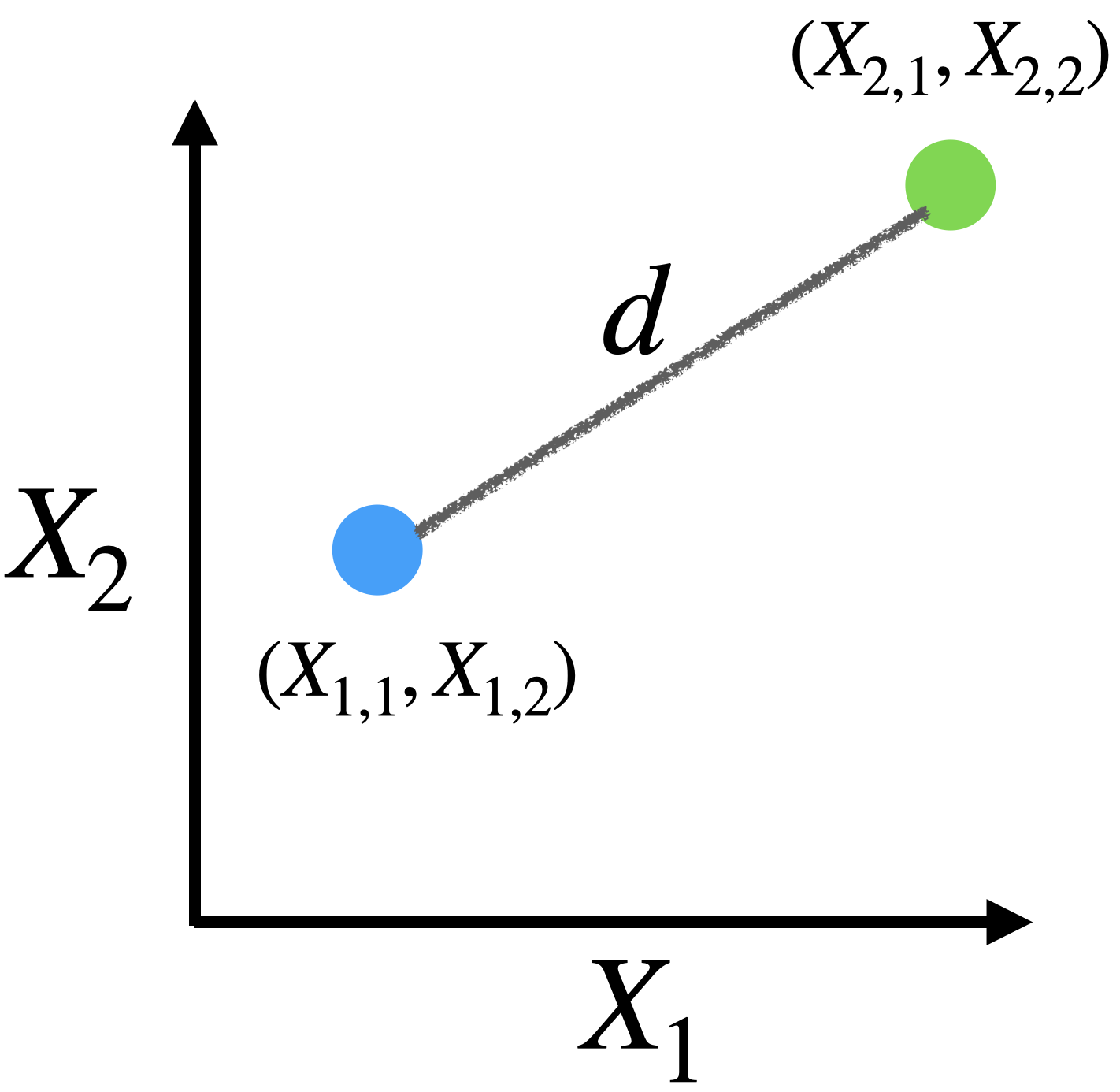
For quantitative predictors, we use the Euclidean distance.
For example, let’s consider two predictors \(X_1\) and \(X_2\) with observations given in the table:
| Observation | \(X_1\) | \(X_2\) |
|---|---|---|
| 1 | \(X_{1,1}\) | \(X_{1,2}\) |
| 2 | \(X_{2,1}\) | \(X_{2,2}\) |
\[d = \sqrt{(X_{1,1} - X_{2,1})^2 + (X_{1,2} - X_{2,2})^2 }\]
We can extend the Euclidean distance to measure the distance between observations when we have more predictors. For example, let’s consider three predictors:
| Observation | \(X_1\) | \(X_2\) | \(X_3\) |
|---|---|---|---|
| 1 | \(X_{1,1}\) | \(X_{1,2}\) | \(X_{1,3}\) |
| 2 | \(X_{2,1}\) | \(X_{2,2}\) | \(X_{2,3}\) |
The Euclidean distance is
\[d = \sqrt{(X_{1,1} - X_{2,1})^2 + (X_{1,2} - X_{2,2})^2 + (X_{1,3} - X_{2,3})^2 }\]
The Euclidean distance depends on the units of measurement of the predictors!
Predictors with certain units have greater importance in calculating the distance.
This is not good since we want all predictors to have equal importance when calculating the Euclidean distance between two observations.
The solution is to standardize the units of the predictors.
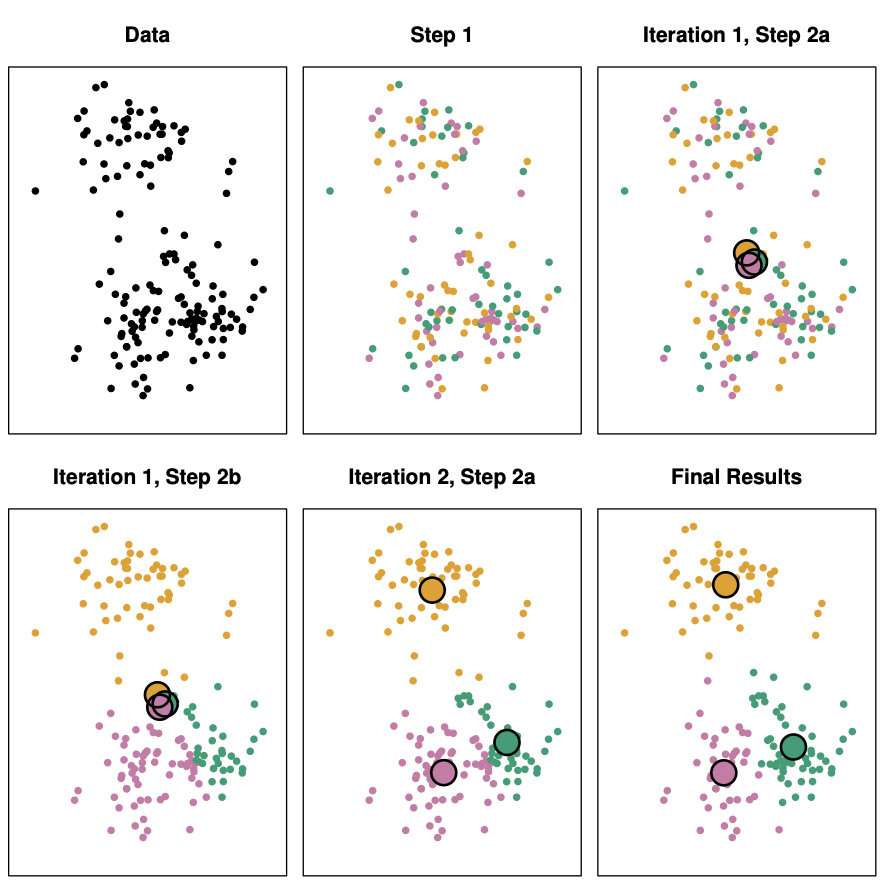
Choose a value for K, the number of groups.

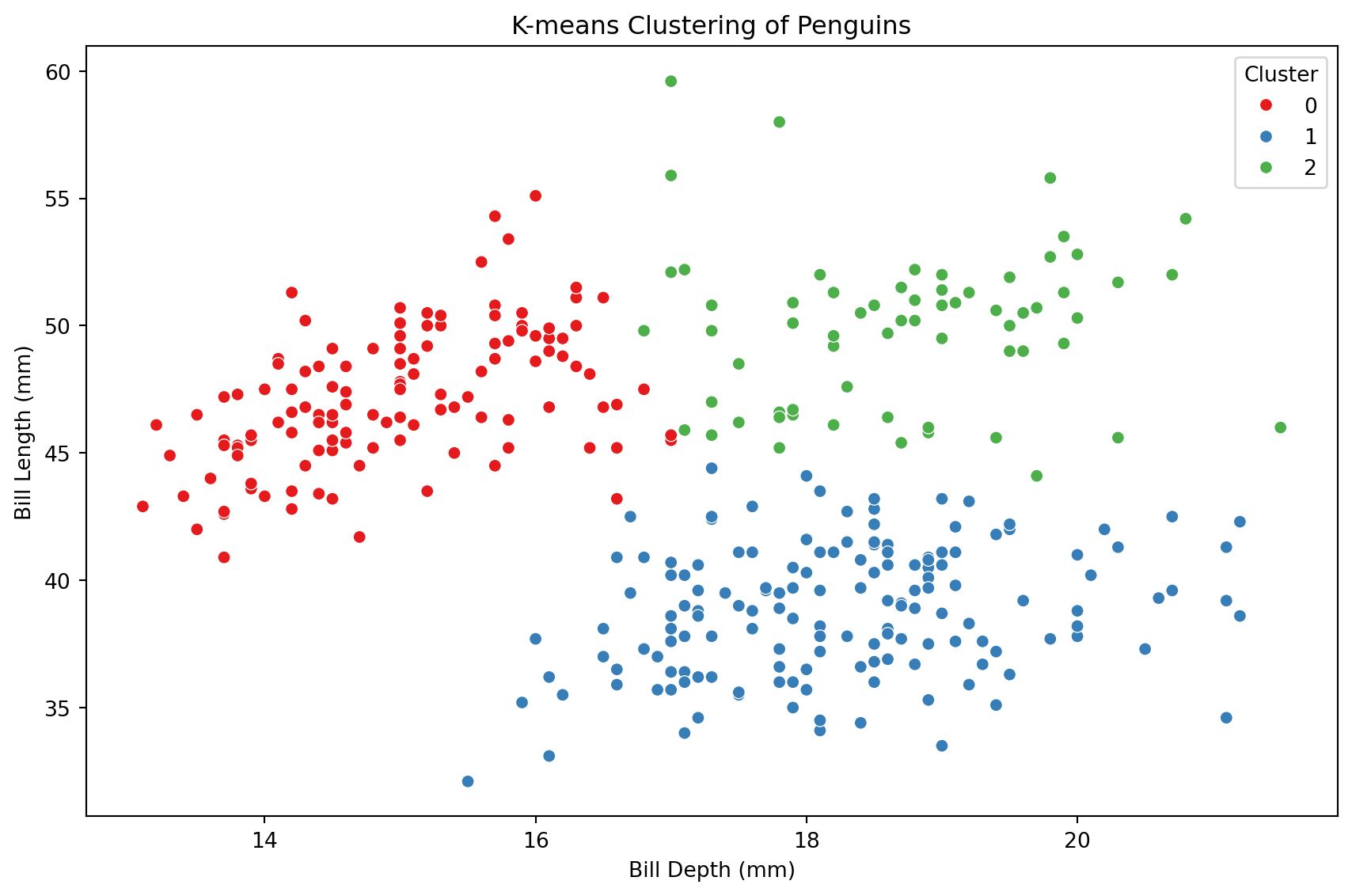
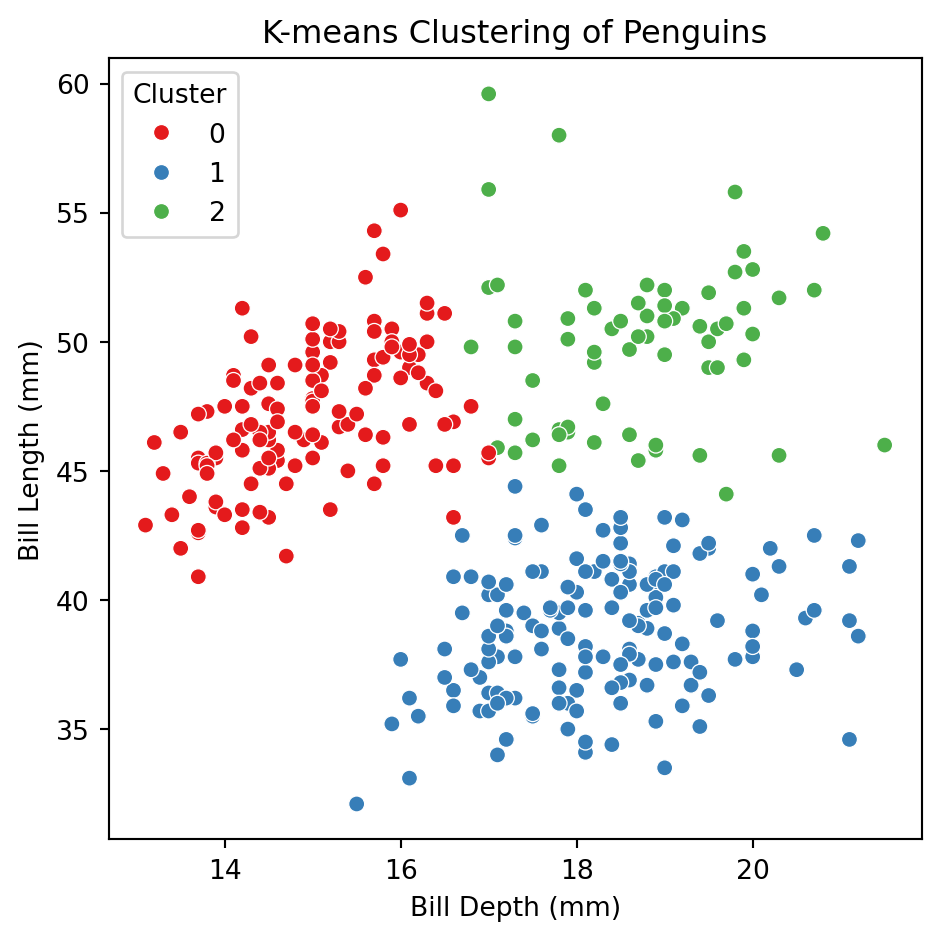
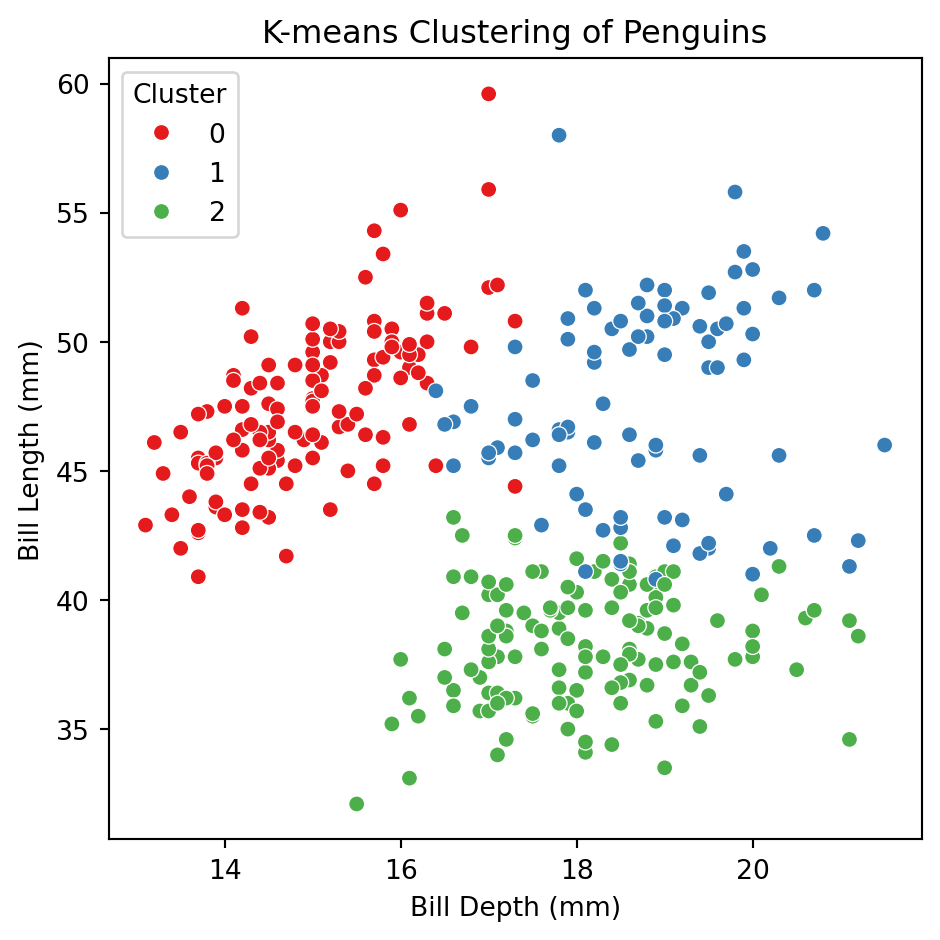
Let’s apply the algorithm to the predictors bill_depth_mm and bill_length_mm of the penguins dataset.
Since the K-means algorithm works with Euclidean distance, we must standardize the predictors before we start. In this way, all of them will be equally informative in the process.
We do this using the function StandardScaler() and fit_transform().
In Python, we use the KMeans() function of sklearn to apply K-means clustering. KMeans() tells Python we want to train a K-means clustering algorithm and .fit_predict() actually trains it using the data.
The argument n_clusters sets the desired number of clusters and random_state allows us to reproduce the analysis.
The clusters created are contained in the clusters object.
array([1, 1, 1, 1, 1, 1, 1, 1, 1, 1, 1, 1, 1, 1, 1, 1, 1, 1, 2, 1, 1, 1,
1, 1, 1, 1, 1, 1, 1, 1, 1, 1, 1, 1, 1, 1, 1, 1, 1, 1, 1, 1, 2, 1,
1, 1, 1, 1, 1, 1, 1, 1, 1, 1, 1, 1, 1, 1, 1, 1, 1, 1, 1, 1, 1, 1,
1, 1, 1, 1, 1, 1, 2, 1, 1, 1, 1, 1, 1, 1, 1, 1, 1, 1, 1, 1, 1, 1,
1, 1, 1, 1, 1, 1, 1, 1, 1, 1, 1, 1, 1, 1, 1, 1, 1, 1, 1, 1, 1, 1,
2, 1, 1, 1, 1, 1, 1, 1, 1, 1, 1, 1, 1, 1, 1, 1, 1, 1, 1, 1, 1, 1,
1, 1, 1, 1, 1, 1, 1, 1, 1, 1, 1, 1, 1, 1, 1, 1, 1, 1, 1, 0, 0, 0,
0, 0, 0, 0, 0, 0, 0, 0, 0, 0, 0, 0, 0, 0, 0, 0, 0, 0, 0, 0, 0, 0,
0, 0, 0, 0, 0, 0, 0, 0, 2, 0, 0, 0, 1, 0, 0, 0, 0, 0, 0, 0, 0, 0,
0, 0, 0, 0, 0, 0, 0, 0, 0, 0, 0, 0, 0, 0, 0, 0, 0, 0, 2, 0, 0, 0,
0, 0, 0, 0, 0, 0, 0, 0, 0, 0, 0, 0, 0, 0, 0, 0, 2, 0, 0, 0, 2, 0,
2, 0, 0, 0, 0, 0, 0, 0, 0, 0, 2, 0, 0, 0, 0, 0, 0, 0, 0, 0, 0, 0,
0, 0, 0, 0, 0, 0, 0, 0, 0, 0, 2, 2, 2, 2, 2, 2, 2, 2, 2, 2, 2, 2,
2, 2, 2, 2, 2, 2, 2, 2, 1, 2, 0, 2, 2, 2, 2, 2, 2, 2, 1, 2, 1, 2,
2, 0, 2, 2, 0, 2, 2, 2, 2, 0, 2, 2, 2, 2, 2, 2, 0, 2, 2, 2, 1, 2,
0, 2, 2, 2, 2, 0, 0, 2, 1, 2, 2, 2], dtype=int32)
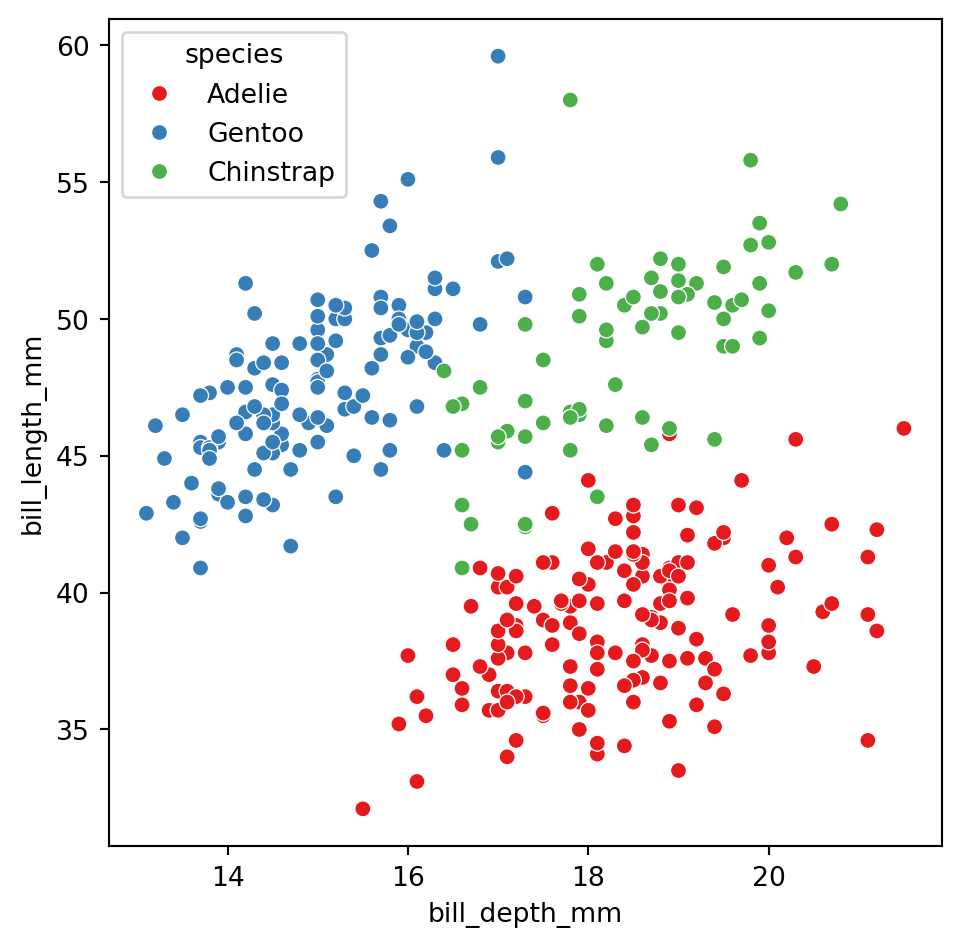
To visualize the clusters, we augment the original dataset X_penguins (without standarization) with the clusters object. usign the code below.


X_penguins = penguins_data.filter(['bill_depth_mm', 'bill_length_mm',
'flipper_length_mm', 'body_mass_g'])
## Standardize
scaler = StandardScaler()
Xs_penguins = scaler.fit_transform(X_penguins)
# Fit KMeans with 3 clusters
kmeans = KMeans(n_clusters = 3, random_state = 301655)
clusters = kmeans.fit_predict(Xs_penguins)
# Save new clusters into the original data
clustered_X = (X_penguins
.assign(Cluster = clusters)
)

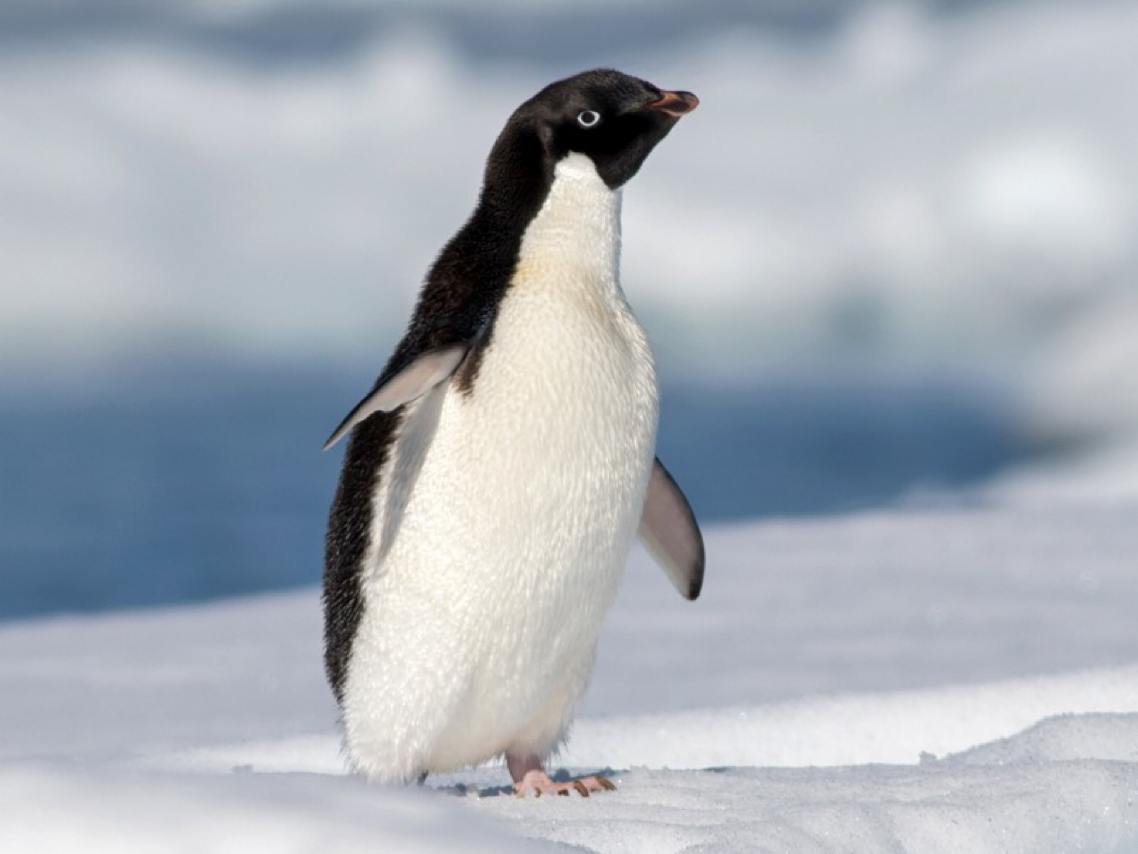
Adelie

Gentoo

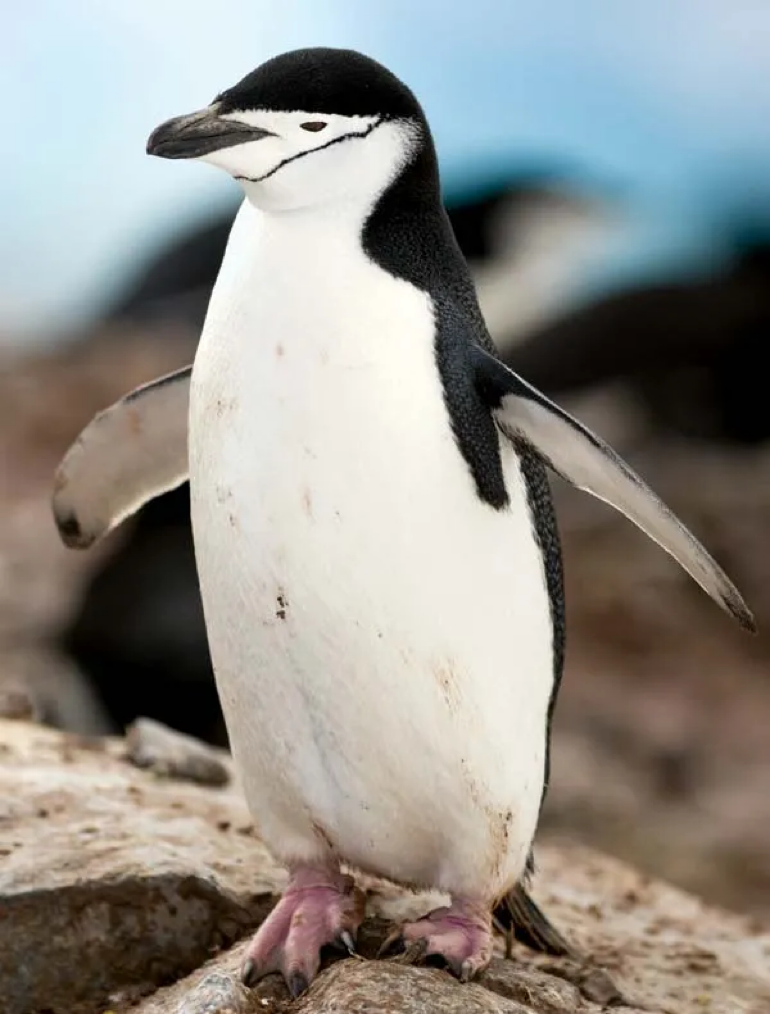
Chinstrap

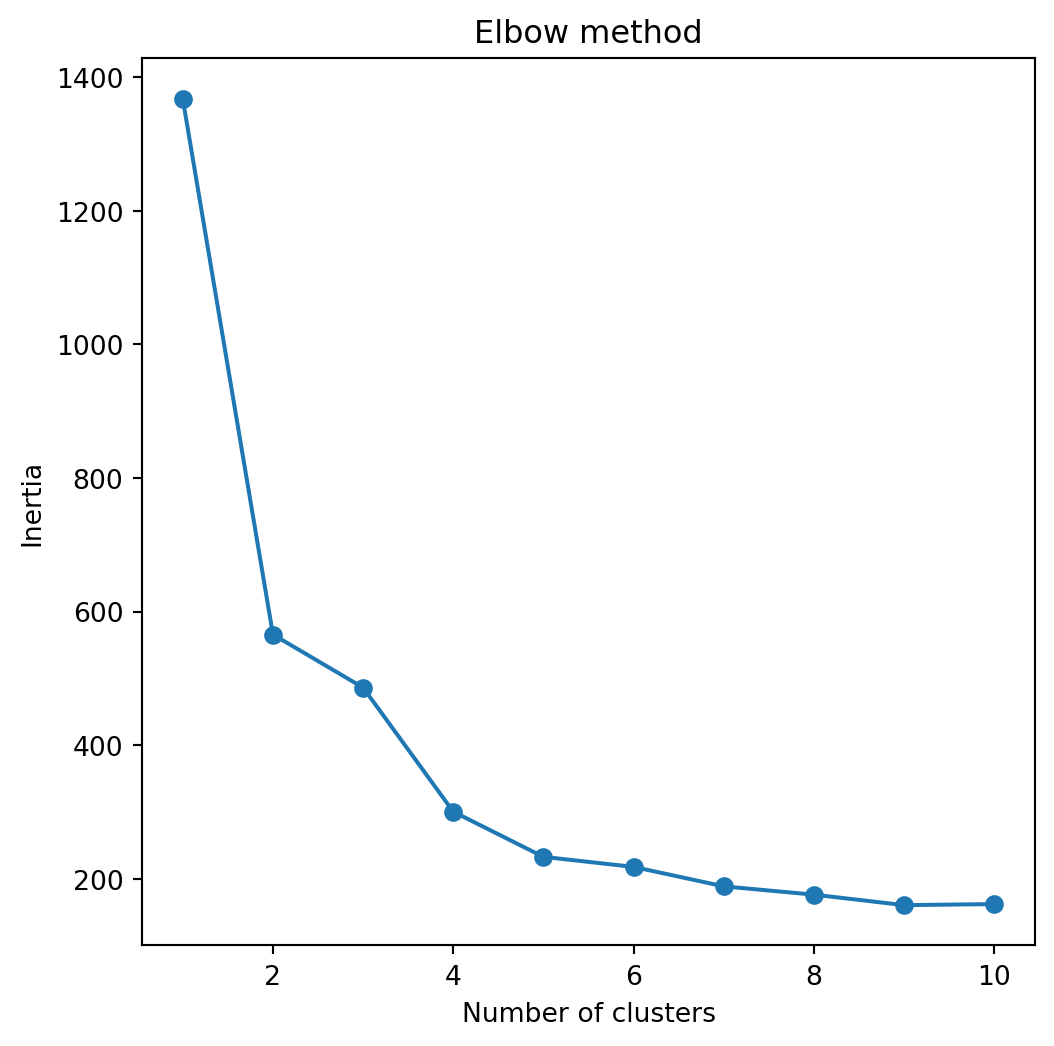
A simple way to determine the number of clusters (K) is recording the quality of clustering for different numbers of clusters.
In sklearn, we can record the inertia of a partition into clusters. Technically, the inertia is the sum of squared distances of observations to their closest cluster center.
The lower the intertia the better because this means that all observations are close to their cluster centers overall.
To record the intertias for different numbers of clusters, we use the code below.
Next, we plot the intertias and look for the elbow in the plot.
The elbow represents a number of clusters for which there is no significant improvement in the quality of the clustering.
In this case, the number of clusters recommended by this elbow method is 3.
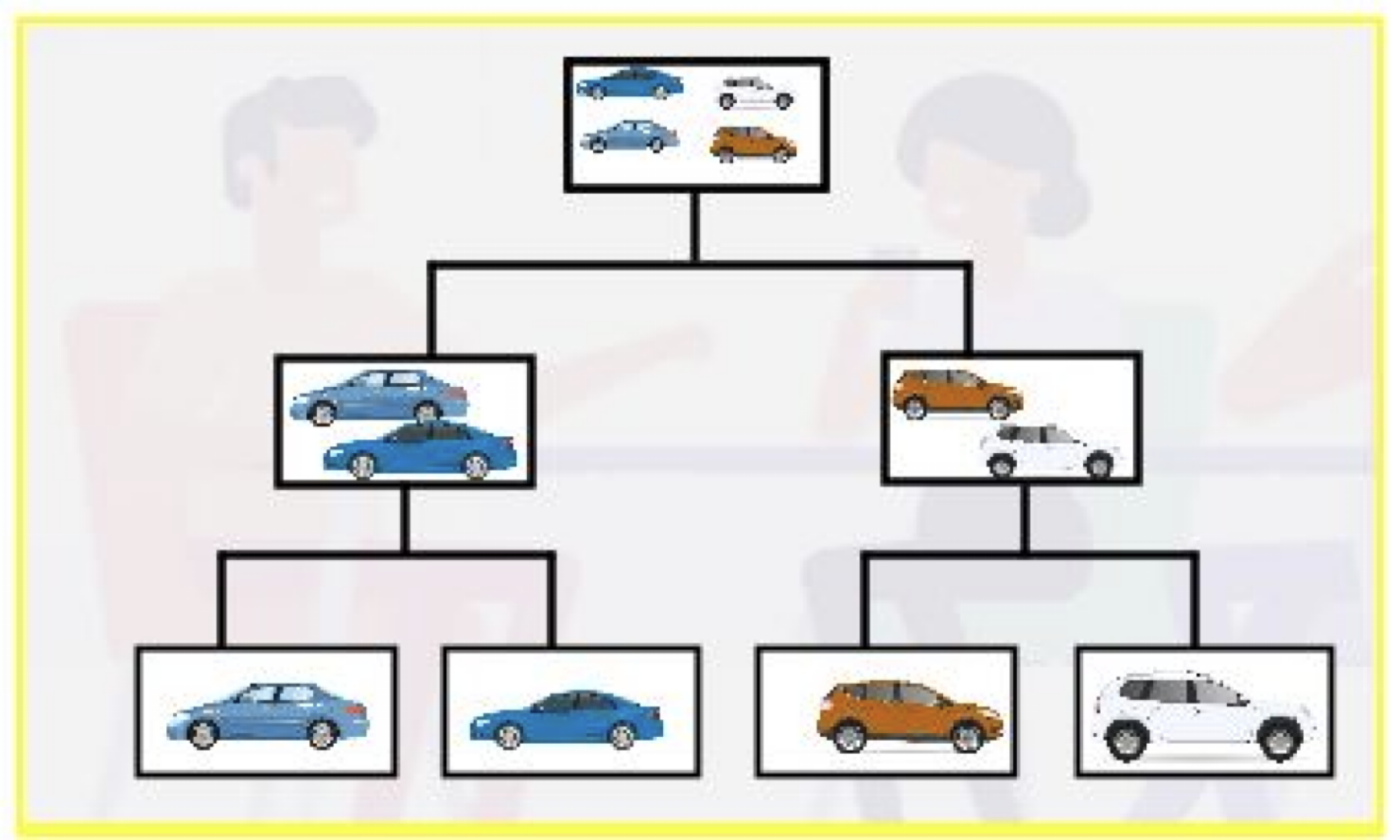
Start with each observation standing alone in its own group.
Then, gradually merge the groups that are close together.
Continue this process until all the observations are in one large group.
Finally, step back and see which grouping works best.
Distance between two observations.
We use Euclidean distance.
We must standardize the predictors!
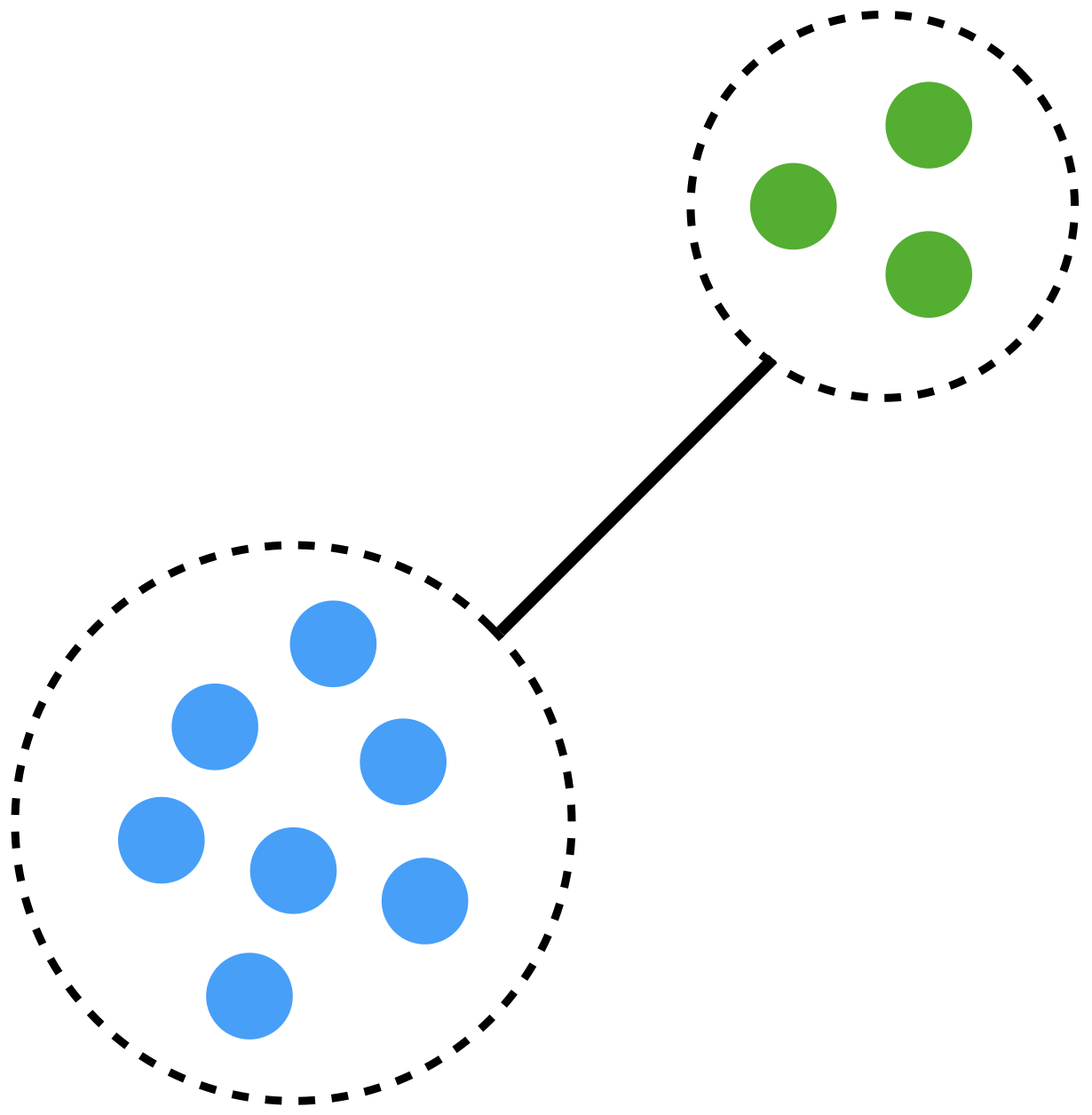
Distance between two groups.
The distance between two groups of observations is called linkage.
There are several types of linking. The most commonly used are:

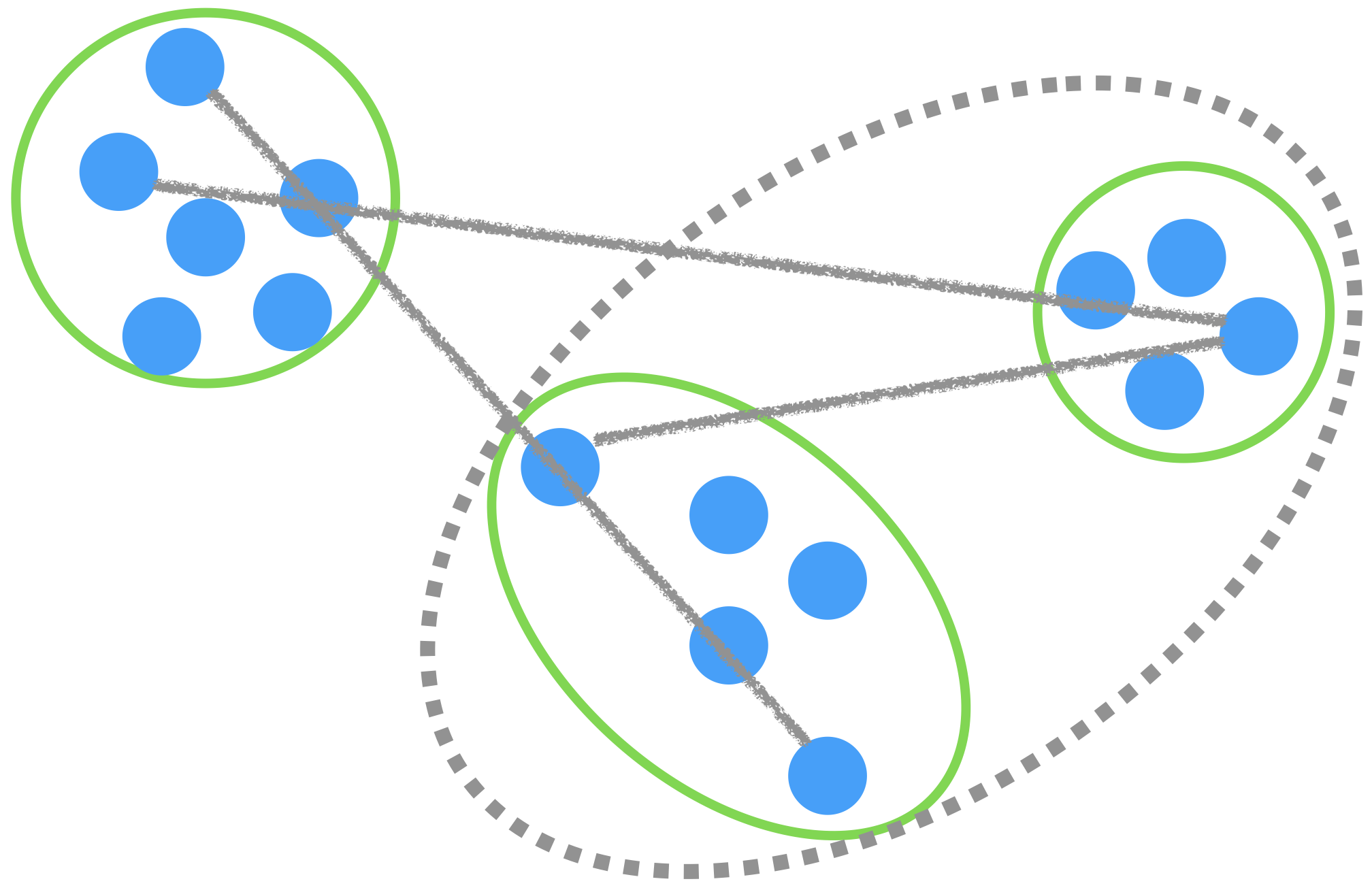
The distance between groups is measured using the largest distance between observations.
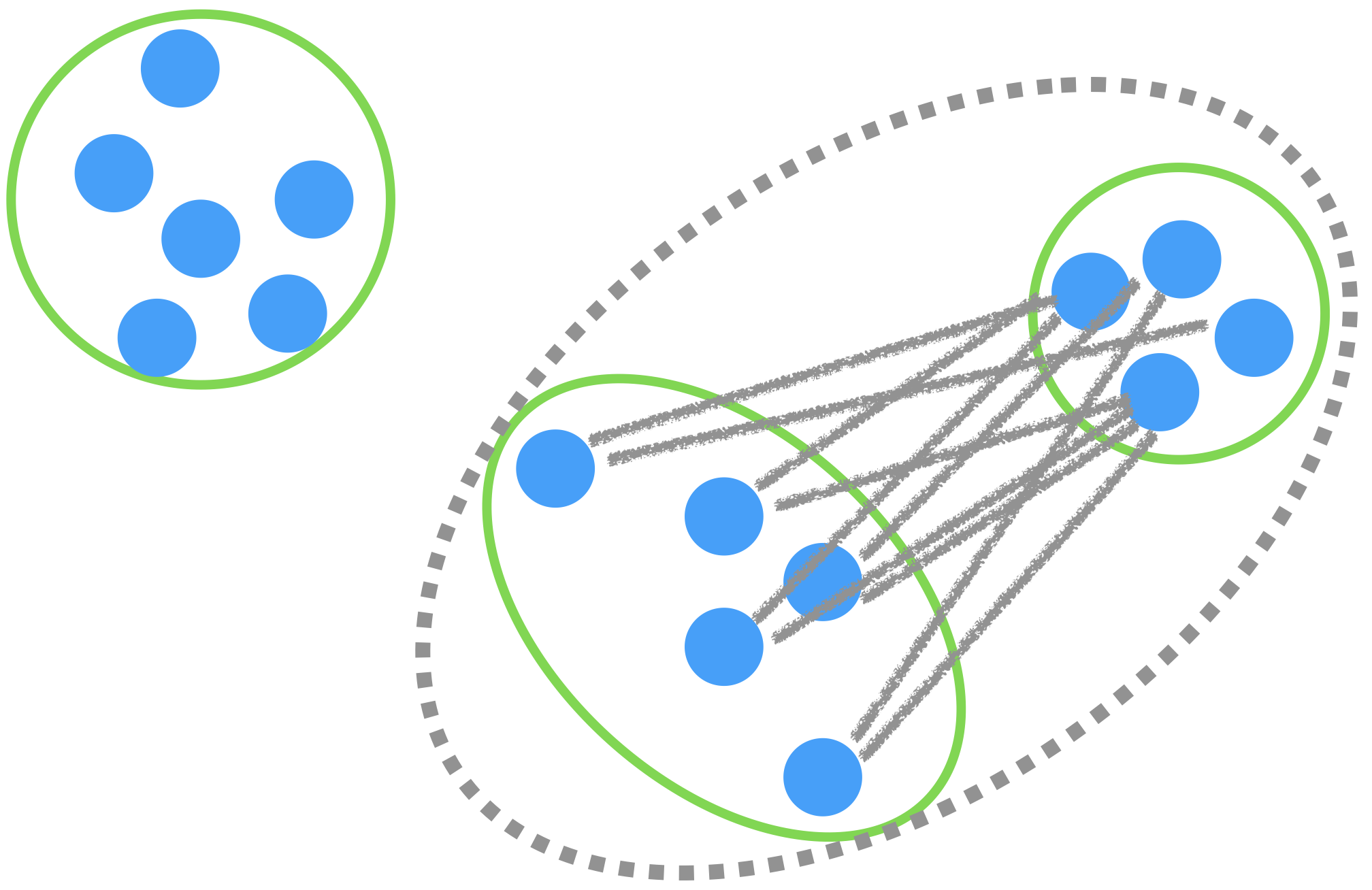
The distance between groups is the average of all the distances between observations.
The steps of the algorithm are as follows:
Let’s consider a dataset called “Cereals.xlsx.” The data includes nutritional information for 77 cereals, among other data.
Here, we will restrict to 7 numeric predictors.
X_cereal = cereal_data.filter(['calories', 'protein', 'fat', 'sodium', 'fiber',
'carbo', 'sugars', 'potass', 'vitamins'])
X_cereal.head()| calories | protein | fat | sodium | fiber | carbo | sugars | potass | vitamins | |
|---|---|---|---|---|---|---|---|---|---|
| 0 | 70 | 4 | 1 | 130 | 10.0 | 5.0 | 6 | 280 | 25 |
| 1 | 120 | 3 | 5 | 15 | 2.0 | 8.0 | 8 | 135 | 0 |
| 2 | 70 | 4 | 1 | 260 | 9.0 | 7.0 | 5 | 320 | 25 |
| 3 | 50 | 4 | 0 | 140 | 14.0 | 8.0 | 0 | 330 | 25 |
| 4 | 110 | 2 | 2 | 200 | 1.0 | 14.0 | 8 | -1 | 25 |
Since the hierarchical clustering algorithm also works with distances, we must standardize the predictors to have an accurate analysis.
Unfortunately, the Agglomerative() function in sklearn is not as user friendly compared to other available functions in Python. In particular, the scipy library has a function called linkage() for hierarchical clustering that works as follows.
The argument method sets the type of linkage to be used.

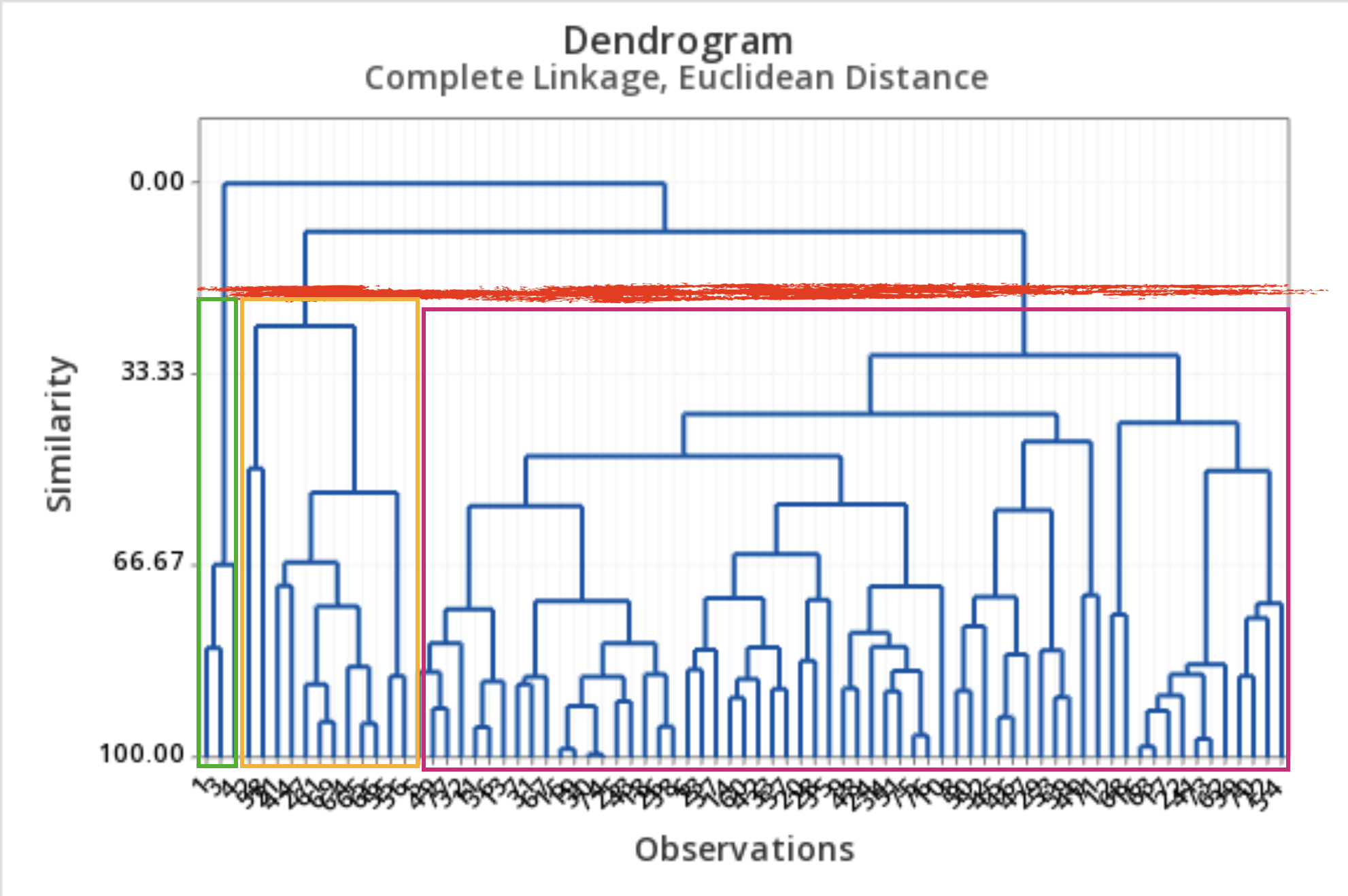
We draw a horizontal line at a specific height to define the groups.
This line defines three groups.

This line defines 5 groups.
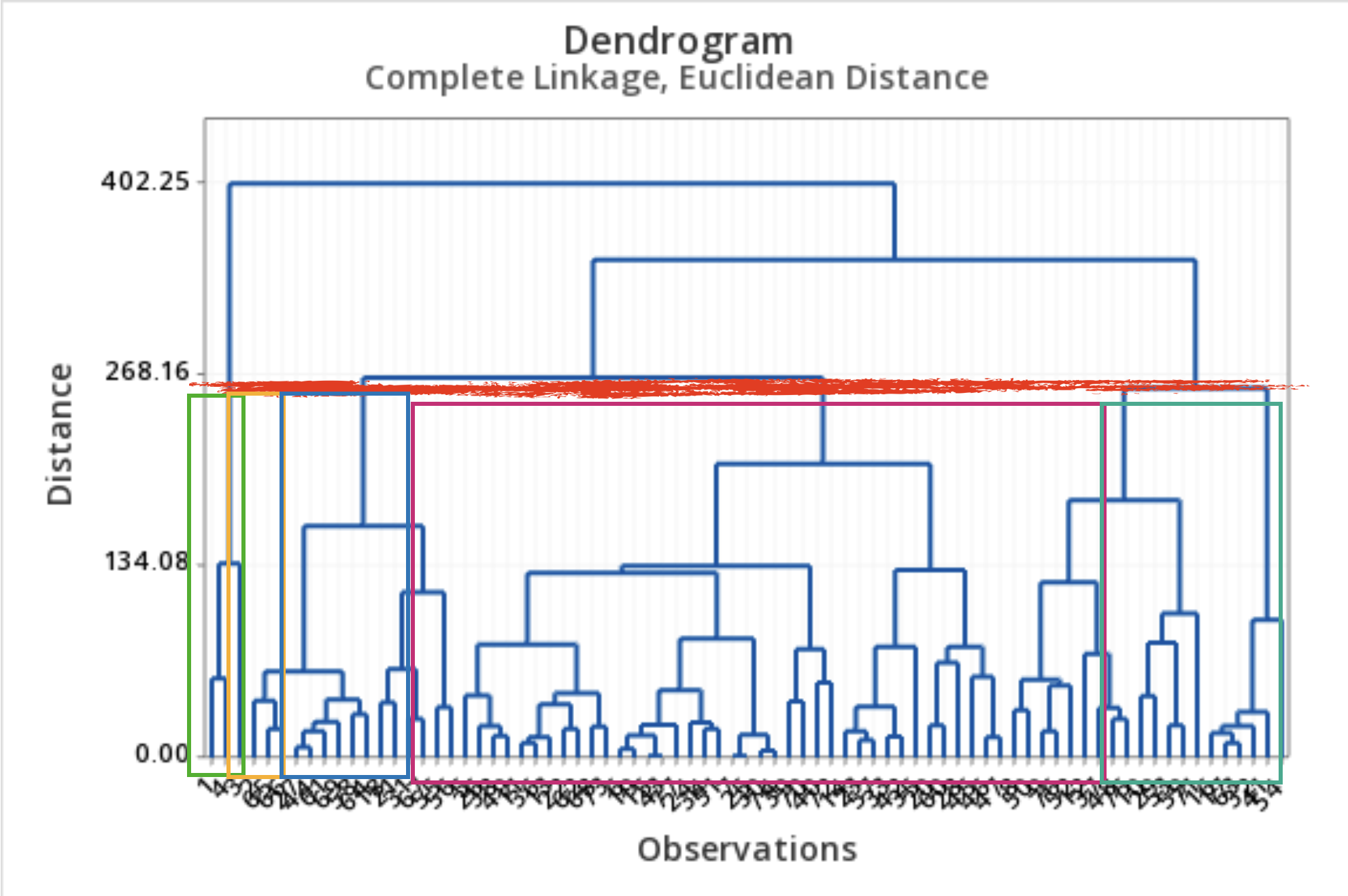
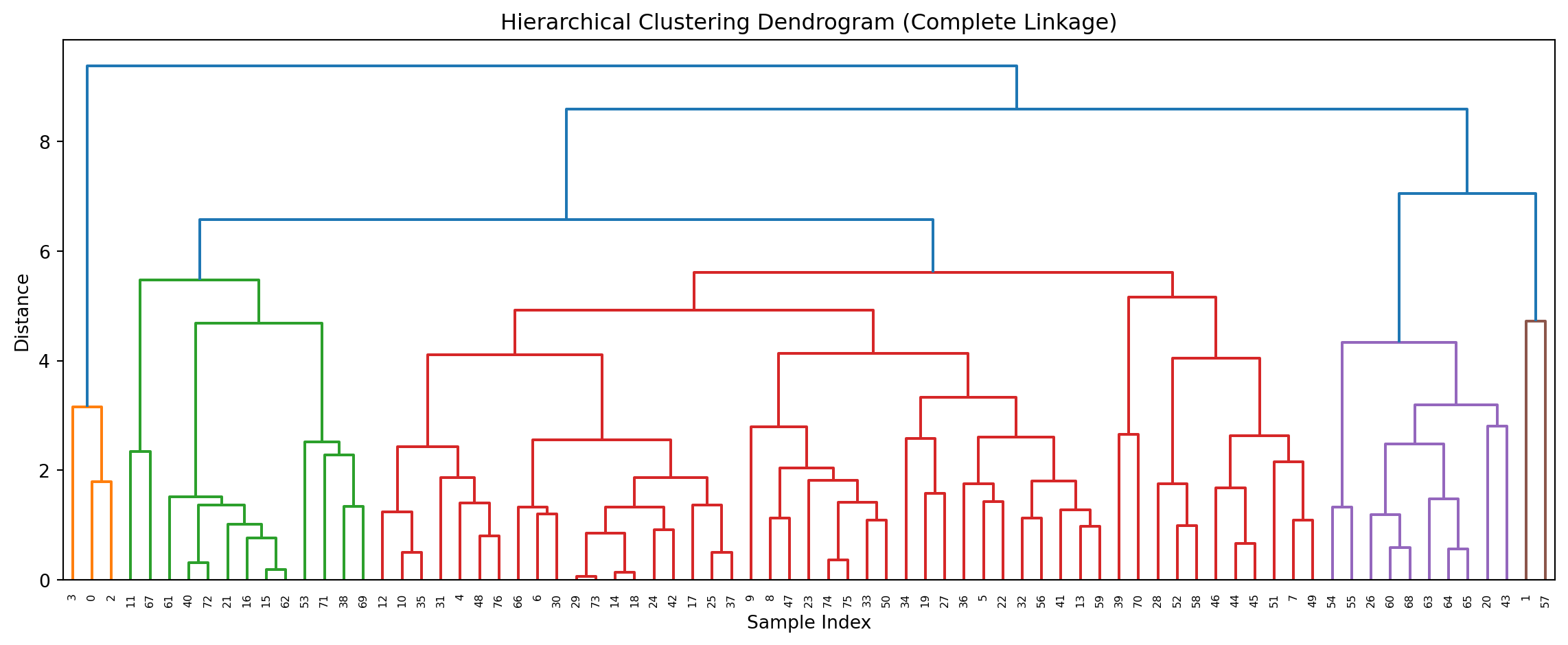
To produce a nice dendrogram in Python, we use the function dendrogram from scipy.

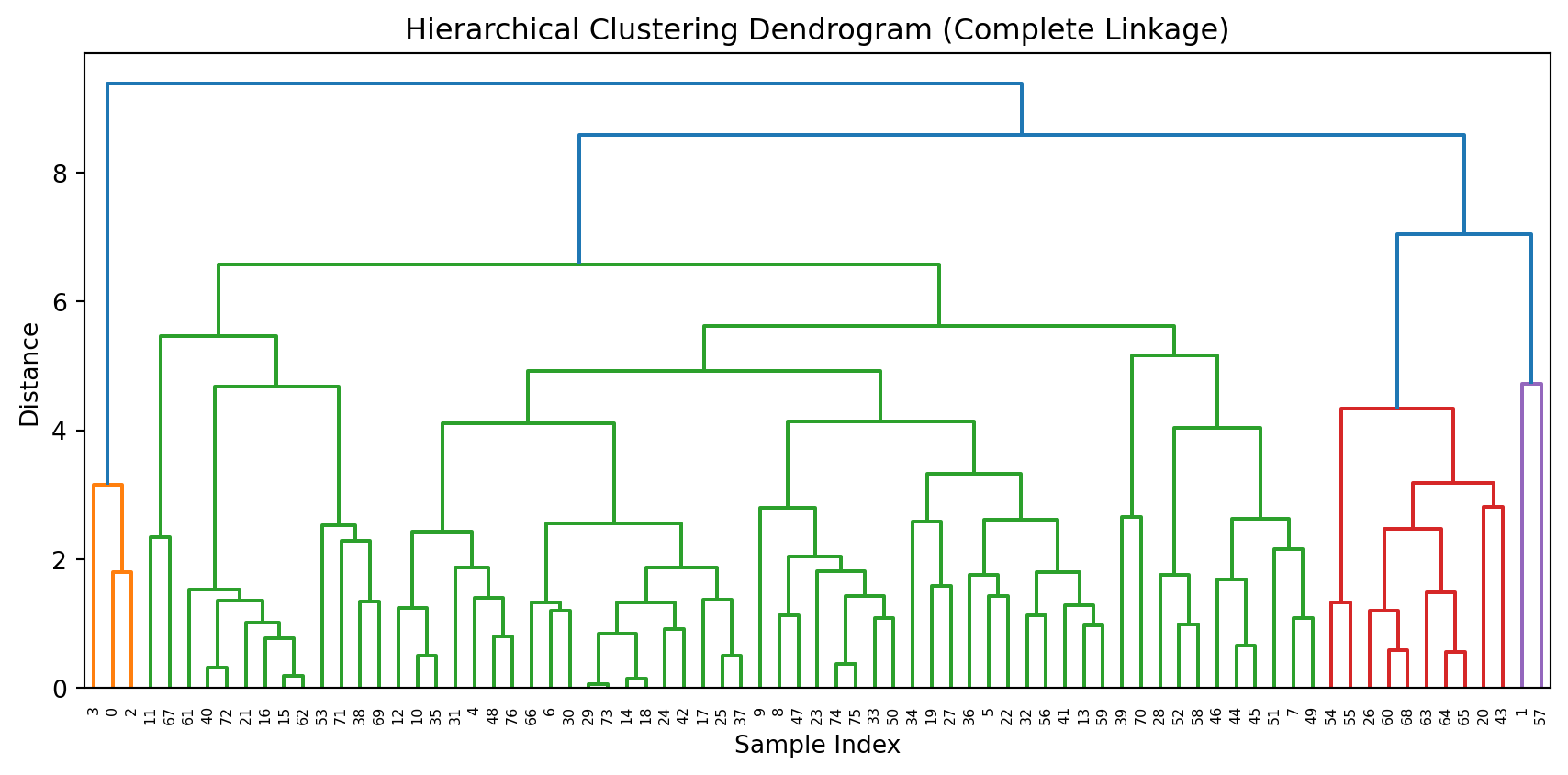
The dendrogram function colors a specific number of groups by default, but we can alter this behavior and color two, three, or more groups. To this end, w must determine the threshold to cut the dendrogram using the code below.
We specify the threshold to cut the dendrogram and set the groups using the color_threshold argument in dendrogram().
Remember to standardize the predictors!
It’s not easy to choose the correct number of clusters using the dendrogram.
The results depend on the linkage measure used.
Hierarchical clustering is useful for detecting outliers.
With these methods, there is no single correct answer; any solution that exposes some interesting aspect of the data should be considered.
James et al. (2017)

Tecnologico de Monterrey
Comments
Selecting the number of clusters K is more of an art than a science. You’d better get K right, or you’ll be detecting patterns where none really exist.
We need to standardize all predictors.
The performance of K-means clustering is affected by the presence of outliers.
The algorithm’s solution is sensitive to the starting point. Because of this, it is typically run multiple times, and the best clustering among all runs is reported.